
The Insurance Fraud Landscape Today
Chapter 1
Insurance fraud has never been static. However, the pace at which it is evolving in sophistication, scale, and the creative audacity of those committing it is accelerating in ways that should focus the minds of everyone in this industry. While fraud is concentrating where it has always been most profitable, the forces driving it are converging to amplify the threat beyond any single dimension.
What makes this moment different is not a single factor, but rather the collision of three:
Economic desperation lowers the moral threshold for fraud.
Technology provides the tools to act on that desperation with scale and sophistication.
Organized networks convert individual willingness into systemic exploitation.
Understanding this convergence, rather than just the data that captures its symptoms, is the foundation for an effective response.
Where Fraud Concentrates and Why That Matters Strategically
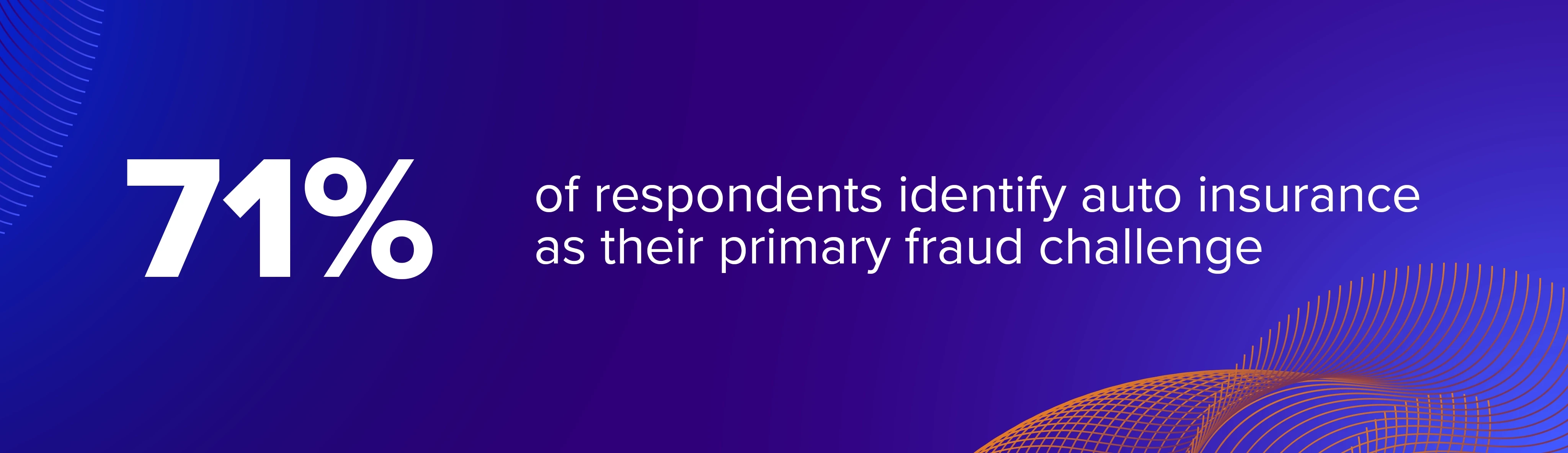
The dominance of auto insurance in the fraud landscape is not coincidental, rather it is structural. Auto is the most transactional line of business insurers operate, characterized by high policy volume, recurring claims, and a process that depends heavily on third-party estimates and physical evidence that is relatively easy to manipulate. Soft-tissue injuries are difficult to disprove, repair estimates are challenging to independently verify, and the sheer velocity of auto claims creates systemic pressure to process quickly, often at the expense of scrutiny.
Property and general insurance accounted for 16% of fraud challenges, while commercial lines represented just 11%. This heavy concentration in auto is not simply a fact about where fraud happens; it is a signal about where initial investments in detection technology will produce the clearest, fastest, and most defensible return on investment.
The deeper strategic implication here is that the line most exposed to fraud is also the one under the highest operational pressure to move fast. Because speed and scrutiny are in structural tension, insurers without AI-powered triage are effectively forced to choose between them. Most choose speed to avoid backlogs, customer complaints, and regulatory attention. That choice creates the exact gap that experienced fraudsters have learned to exploit, and it is precisely the kind of tradeoff that technology is now being asked to resolve. For organizations still building the internal case for AI adoption, the auto line is where the proof of concept practically writes itself.
71%
16%
11%
2%
Auto insurance
Property / General insurance
Commercial
Other
The Anatomy of Fraud: What Schemes Actually Dominate
Opportunistic fraud, defined as the inflation or exaggeration of an otherwise legitimate claim, remains the most common scenario observed at 44%. This is the most democratized form of fraud in existence. It requires no network and no technical skill, and it is easily rationalized by individuals under financial pressure. The calculus is simple: the policyholder has paid premiums for years, the insurer is a faceless institution, and the marginal fraud feels victimless. It is not, of course, but that is not how the fraudster frames it.
Fake injury claims follow at 29%, a figure that deserves particular concern. Soft-tissue injuries remain among the most difficult to disprove without objective diagnostic evidence or AI-assisted pattern recognition across claim histories. A practitioner who flags a suspicious injury claim has nothing concrete to work with unless the underlying data infrastructure supports that intuition.
Organized crime accounts for 13% of fraud, while rate evasion sits at 9%. The fact that organized crime registers lower than opportunistic fraud should not be misread as reassurance. Organized fraud is far more costly per incident; making it merely less common. The illustrative examples from practitioners in the industry including a series of 14 staged bicycle accidents by a single perpetrator, a car dealership running a systematic fake VIN scheme, and cross-border fraud where the insurer has no investigative reach. These are not edge cases. They represent the creative, coordinated, and increasingly international face of modern organized fraud.
44%
29%
13%
9%
Opportunistic fraud (exaggeration)
Fake injury claims
Organized crime
Rate evasion
The Forces Driving the Next Two Years
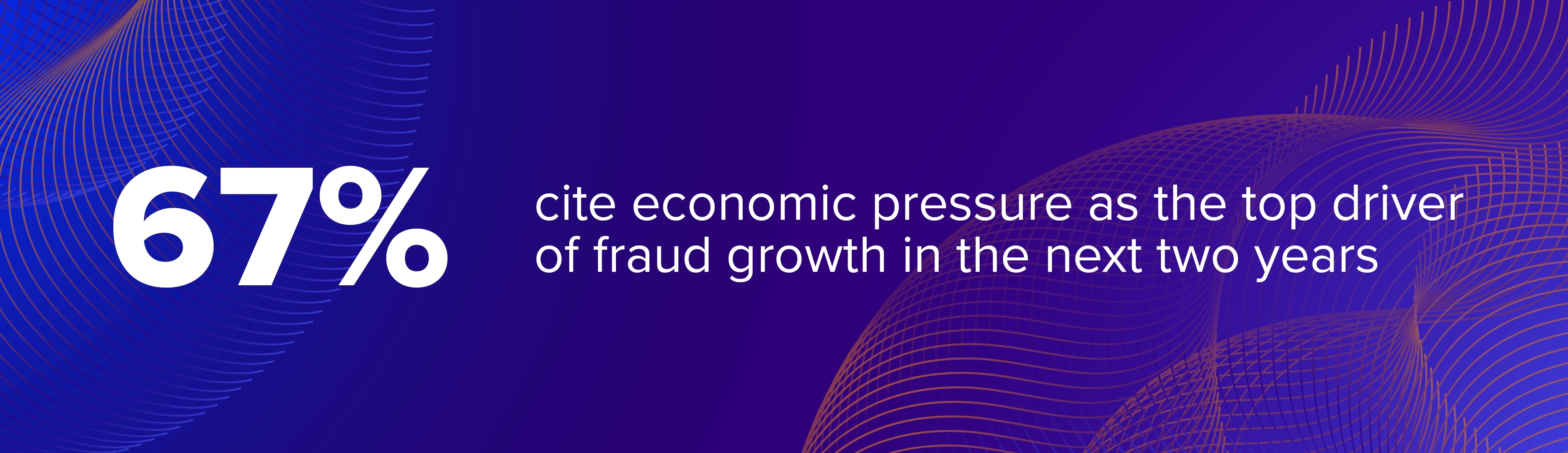
Economic pressure tops the list of drivers at 67%, which is a direct expression of what practitioners are seeing on the ground. Cost-of-living pressures do not cause people to become fraudsters overnight, but they shift the calculus. They lower the moral threshold, make rationalization easier, and expand the pool of people willing to cross a line they would not have crossed in more comfortable circumstances.
Advancements in fraud technology follow at 60%, and organized fraud rings sit at 58%. This ranking matters, as it tells us that practitioners do not see the primary threat as systemic or environmental, but rather behavioral and technological. Regulatory changes (18%) and catastrophic weather events (16%) both registered significantly lower, confirming that the arms race being fought is between people and tools, not between insurers and macro forces they cannot control.
The crucial insight is that these three forces are not independent. Economic desperation creates motive, technology creates capability, and organized rings provide the infrastructure to scale both. Together, they produce a threat environment that is simultaneously more widespread and more capable than any single factor could create in isolation. Any strategy that addresses one of these drivers without the others will be insufficient.
67%
60%
58%
18%
16%
Economic pressures / cost of living
Advancements in fraud technology
Organized fraud rings
Regulatory changes
Catastrophic weather events (CATs)
A Bifurcating Landscape: Two Threats Requiring Two Strategies

Fifty-eight percent of respondents report that fraud schemes have increased in volume or complexity, while 39% report no noticeable change, and 11% report a decrease. This divergence is not a contradiction; rather, it is a meaningful signal about the shape of the threat.
The fraud landscape is bifurcating. At the frontier, a more technologically sophisticated tier of fraud is emerging, powered by AI, synthetic identities, and coordinated organized networks. Below it, the bulk of day-to-day fraud remains opportunistic, low-tech, and volume-driven.
These two tiers require fundamentally different responses:
High-Volume Opportunistic Fraud: Demands operational efficiency and scalable, automated detection.
Sophisticated Organized Fraud: Demands analytical depth, cross-insurer intelligence sharing, and advanced AI capabilities that can detect novel patterns rather than just match known ones.
The risk for insurers lies in designing a strategy that addresses only one end of this spectrum, such as deploying AI for sophisticated fraud while neglecting process improvements for opportunistic fraud or investing in manual investigation while missing the emerging wave of AI-powered schemes. The gap between where the industry is operating and where the threat is heading has never been more consequential to close.
Key Takeaway
Fraud is not simply growing; it is bifurcating. At the frontier, AI-powered and organized schemes are becoming more sophisticated. Below it, opportunistic fraud scales with economic pressure. No single strategy addresses both. The organizations best positioned for the future are those that build for volume and sophistication simultaneously, rather than waiting until one threat overwhelms the other.