Collaboration And What The Industry Must Do Next
Chapter 4
What the data across this study makes clear is that the individual insurer acting alone, with only their own data, tools, and investigative capacity, is increasingly outmatched by fraud operations that operate across borders, carriers, and the full digital surface area of the insurance transaction. The data does not point toward incremental improvement; instead, it demands structural transformation.
The competitive instinct that has historically kept insurers operating in isolation on fraud is now a collective liability. Data sharing, joint intelligence, and shared infrastructure are not strategic options to be weighed against alternatives. They are the architecture that makes every other fraud control strategy more effective, and they represent the only response that matches the scale of what is coming.
What Collaboration Actually Means in Practice
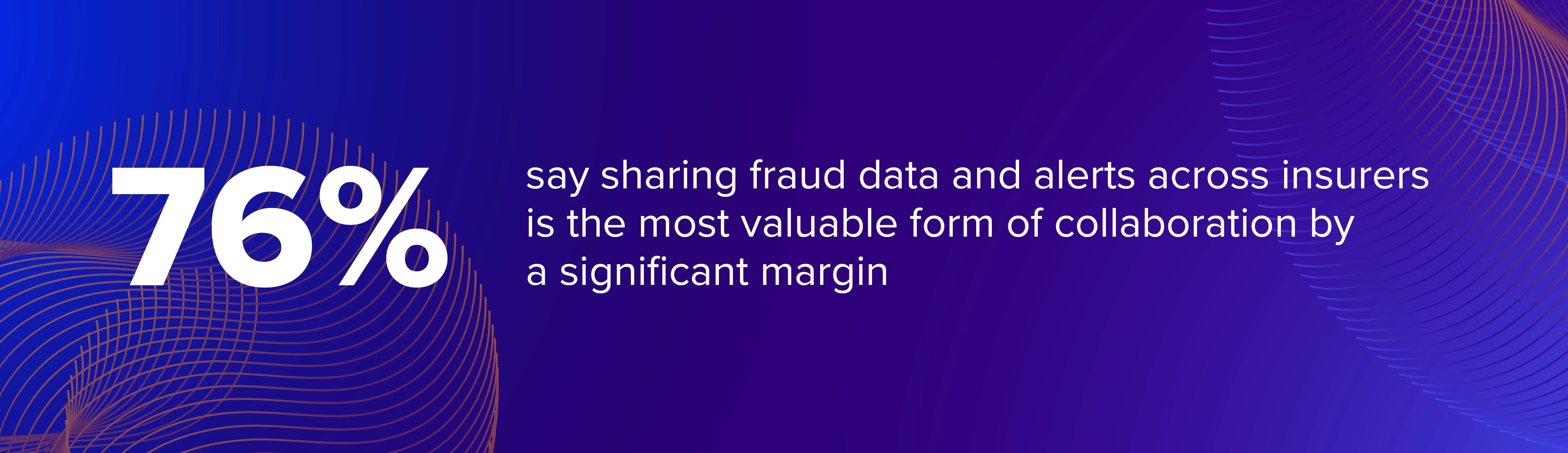
Sharing fraud data and alerts across insurers topped the collaboration list at 76%. Joint investigative task forces between insurers followed at 56%, public-private partnerships with regulators and law enforcement at 51%, partnerships with InsurTech vendors at 40%, and international cooperation at 29%.
The primacy of data sharing deserves more than acknowledgment; it deserves serious reflection about what it means structurally. Fraud intelligence is only as good as its breadth. A fraudster who successfully defrauds one insurer carries that track record invisibly when approaching a second. Each insurer, operating in isolation, effectively starts from zero, detecting the same patterns independently, paying for the same losses, and leaving gaps that experienced fraudsters have learned to exploit systematically. The value of shared intelligence is not additive; it is multiplicative.
Consider the agentic AI threat in this context. Agentic AI systems, if deployed for fraud, will not target a single insurer. Instead, they will probe the entire market for vulnerabilities, learn from every interaction, and scale what works. The only defense that matches the scale of that threat is collective intelligence that covers the entire market, ensuring that what one insurer detects, the entire industry can act on. The 76% of respondents who want shared data and alerts are not describing a nice-to-have feature; they are describing the foundational infrastructure that makes every other fraud control strategy more effective.
76%
56%
51%
40%
29%
Sharing fraud data and alerts across insurers
Joint investigative task forces between insurers
Public-private partnerships (regulators / law enforcement)
Partnerships with InsurTech vendors
International cooperation on fraud detection
What Stands in the Way and What It Reveals About Readiness
Budget and resource limitations (27%) lead as the biggest barrier to an effective response. This represents the single most pervasive constraint across every dimension of the fraud response, matching what practitioners report regarding AI adoption. Keeping pace with evolving fraud tactics (24%) follows, which is a challenge directly linked to the technology gap, since the organizations best positioned to keep pace are those with AI-powered detection that learns and adapts rather than relying on static rules.
Internal data quality issues (16%) and organizational silos (16%) are particularly revealing when read together. These are internal barriers to an internal capability that is itself a prerequisite for external collaboration. Before the industry can share fraud intelligence across carriers, individual organizations need clean, structured, and accessible data internally. The path to collective defense runs through internal data transformation first. Organizations that have not invested in that transformation cannot meaningfully participate in industry-wide intelligence sharing, not because they are unwilling, but because their data is not in a state that makes sharing valuable.
Regulatory and privacy barriers (13%) come in last, as most practitioners view these as navigable rather than prohibitive. The frameworks needed to enable insurance data sharing already exist in adjacent sectors; financial services, healthcare, and government all have models worth studying and adapting. The barriers that actually prevent progress are organizational and financial, not fundamentally legal.
27%
24%
16%
16%
13%
Budgetary / resource limitations
Keeping up with evolving fraud tactics
Internal data quality
Organizational silos
Regulatory / privacy barriers
Three Imperatives: What the Industry Must Do Next
The data across this study points toward three distinct priorities. These are not independent recommendations that can be actioned in sequence; rather, they are mutually reinforcing imperatives. Progress on any single priority makes the others easier to achieve, while failure on any one undermines the entire strategy.
Close the AI Adoption Gap Before Fraudsters Widen It
Seventy-two percent of insurers are planning or piloting AI, and the benefits are proven. Budget and data quality are real barriers, but they are entirely solvable. Solving them must be treated as a strategic priority rather than an operational one. The organizations that close this gap in the next 12 to 18 months will be structurally better positioned against every form of fraud that follows. With agentic AI threats expected to materialize within two years, the preparation window is already closing. Every quarter spent in planning mode is a quarter spent unprotected.
Build Document and Media Verification Into Every Claims Workflow
Fifty-eight percent of practitioners expect deepfakes to become the dominant fraud tool, yet only 20% treat media verification as critical today. That gap is not a planning problem; it is a direct exposure. Every claims workflow, across every line of business and from first notice of loss (FNOL) to settlement, needs to include authenticity checking for photos, documents, and video as a standard step rather than an exception. The technology exists and the threat is present. The decision to deploy is organizational, not technical.
Make Data Sharing the Industry's Next Infrastructure Project
Seventy-six percent of respondents want shared fraud data and alerts. The regulatory and technical frameworks to enable this already exist in financial services, healthcare, and government. Insurance needs a shared fraud intelligence layer, not as a future aspiration, but as foundational infrastructure for what is coming. Internal data quality must be treated as a prerequisite and addressed in parallel, because a shared intelligence network is only as strong as the data that flows into it from each participant.

The practitioners who participated in this study are not alarmists. They are experienced professionals who have spent careers building fraud defenses, developing investigator instincts, and understanding the creative adaptability of those who exploit the insurance system. When 78% of them say agentic AI will influence fraud within two years, and only 2% say they feel very well prepared, that is not a data point to be managed; it is a definitive call to action.
The good news is that the path forward is not opaque. The priorities are clear, the proof of value exists, and the frameworks for collaboration already function in adjacent industries. What is required now is organizational urgency, the explicit recognition that the window for preparation is present but not unlimited. The cost of moving slowly is already being paid incrementally every day in fraud losses, customer friction, and competitive disadvantage.
The industry knows what it needs to do. The question this study ultimately raises is whether insurers will act on that knowledge before the threat scales past the point where catching up becomes the only option left.